Back in October 2001, the US-led invasion of Afghanistan adopted an humanitarian face, professing that the defeat of the Taliban would rid girls and women of an infamously cruel brand of misogyny.
But the Taliban’s violent oppression was not alone in denying the country’s females of their basic right to education, health, inheritance, and physical and emotional safety inside and outside of their homes.
-
-
In the first week of October, primary and secondary teachers on Spain’s Balearic Islands (Mallorca, Menorca, Ibiza and Formentera) voted by large majorities to suspend their indefinite strike.
-
When the global financial crisis (GFC) unfolded in 2008, the unemployment rate for 15 to 19-year-olds looking for full-time work in Australia increased from 15% to 25%. It has remained at this level ever since. In July, it stood at 25.5%. However, in the 10 areas listed by the Department of Human Services as the most disadvantaged in the country, the youth unemployment rate is more than 40%.
-
Last month 20,000 people rallied against education cuts by the state government.
-
After a hard-fought industrial campaign, the National Tertiary Education Union (NTEU) at the University of Sydney has just voted to accept a new workplace agreement.
-
Bolivia's President Evo Morales issued a government decree on October 7 that allows workers to establish “social enterprises” in businesses that are bankrupt, winding up, unjustifiably closed or abandoned. These enterprises, while private, will be operated by the workers and qualify for government assistance.
-
Amid bitter recriminations between the Democrats and Republicans over the partial shutdown of the government and the Republican threat of forcing of a United States government default, it is easy to forget what their policies have in common. Both have intervened to protect the interests of the capitalist class as a whole in the aftermath of the Great Recession at the expense of the working class. This is indisputable given statistics showing profits are soaring while real wages are declining. Both parties have implemented policies that cut the social wage for working people. -
Germany’s September 22 federal elections delivered victory to the ruling conservative Christian Democratic Alliance, despite forces to their left winning a majority of seats. Die Linke (the Left Party) has emerged the third largest in the Bundestag (German parliament). The Chancellor Angela Merkel-led alliance scored their best result since German re-unification in 1990, with more than 18 million votes (41.5%). -
An international solidarity campaign has been launched after United Nations secretary-general Ban Ki Moon derecognised unions representing the groups's 65,000 workers. Unions have been seeking greater protection for members undertaking increasingly dangerous missions. Most are united in the Co-ordinating Committee for Staff Unions and Associations (CCISUA). CCISUA says that in the last 10 years there have been 555 attacks on UN staff and more than 200 deaths. The unions have been seeking improved health and safety protection and a reduction in the use of private security contractors.
-
More workers will die for World Cup than players will play “'More workers will die building World Cup infrastructure than players will take to the field,' predicts Sharan Burrow, general secretary of the International Trade Union Confederation [on the 2022 World Cup in Qatar]. Even if the teams in Qatar use all their substitutes, she is likely to be right.
-
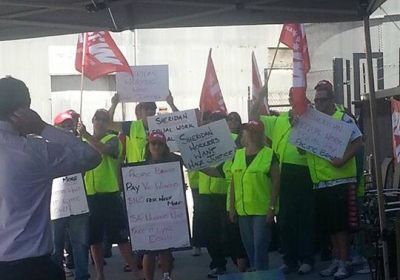
Bangladesh police have used batons, rubber bullets and tear gas in a bid to stop ongoing protests by garment workers demanding higher wages. But the fifth day of protests in two industrial districts near the capital Dhaka, on September 25, forced the closure more than 100 factories for the day, police said. Gazipur and Narayanganj house hundreds of factories that supply garment products to numerous global brands, including Wal-Mart and H&M. After a three-day work stoppage in the wake of the protests, bosses tried to restart the factories today, but the efforts failed.
-
Hong Kong-based business executive Bruce Rockowitz told the New York Times recently that consumers are ultimately the ones responsible for dangerous conditions in garment assembly plants in the global South. The problem is that improved safety would raise the price of clothing, according to Rockowitz, who heads Li & Fung Limited, a sourcing company that hooks up retailers like Macy’s and Kohl’s with suppliers in low-wage countries like Bangladesh. “So far”, he said, “consumers have just not been willing to accept higher costs”.