-
As they are prone to do, the private media have invented a new thing. In both English and Spanish, they are calling it the colectivos. They are meant to be irrational, cruel, grotesque armed motorbike riders who “enforce” the revolution in Venezuela and are responsible for most of the violence afflicting the South American nation, which has left more than 30 people dead since February. The opposition barricaders are presented as the innocent victims of these collectivos, who apparently work with the National Guard and have the support of President Nicolas Maduro's government. -
Via Campesina is a global organisation of peasants and one of the largest and most significant international social movements. The statement below in solidarity with Venezuela’s revolution and peasants was released by its International Coordinating Commission of Via Campesina International, which met in Managua, Nicaragua on March 29. *** -
When the later president Hugo Chavez was first elected president in 1998, it began a process of change that has sought to expand the democratic and social rights of the poor majority who had previously been excluded. This process is known as the Bolivarian revolution. It has included a new constitution guaranteeing previously unheard of social rights, re-nationalising the oil industry and promoting participatory democracy. -
Campaigning in India's general elections, to be held in phases over April 7 to May 12, has already been marked by a reign of terror that has included the assassination of left activists. -
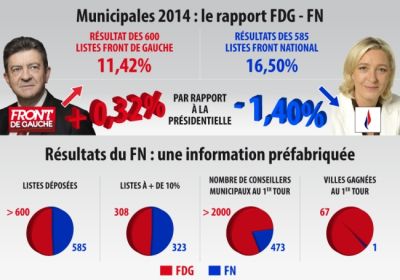
Mainstream media coverage of the first round of France's March 23 local elections stressed the rise in support for the far-right, racist National Front (FN). The only other stories found worthy of comment were the sharp decline in support for the ruling Socialist Party (PS) of president Francois Hollande and the rise in abstention to a record 36.5%. -
Cuba & Its Neighbours: Democracy in Motion By Arnold August Fernwood Publishing January 2013 288pp, C$29.95 Surrounded by emerging participatory democracies unshackling themselves from US hegemony, Arnold August writes that Cuba is a laboratory for people-powered politics. -
What is really going on in Venuezuela since January. An important antidote to the corporate media attacks on Venezuela, its democracy and popular revolution.
-
Venezuelan students who support the Bolivarian Revolution speak out against recent oppositional violence, and urge the nation's youth to think for themselves in the midst of the media-backed polarisation.
-
The news below is mostly accumulated from recent coverage at Venezuela Analysis, asides from the first report from Prensa Latina. Venezuela Analysis is the best English-language source of news and analysis on Venezuela, its popular revolutionary process and the media war against the country and its democracy.
-
Images forge reality, granting a power to television and video and even still photographs that can burrow deep into people’s consciousness without them even knowing it. I thought that I, too, was immune to the repetitious portrayals of Venezuela as a failed state in the throes of a popular rebellion. But I wasn’t prepared for what I saw in Caracas this month: how little of daily life appeared to be affected by the right-wing protests, the normality that prevailed in the vast majority of the city. I, too, had been taken in by media imagery. -
Marking one year since the untimely death of former Venezuelan president Hugo Chavez, eminent writer and film maker Tariq Ali gave a passionate memorial lecture in central London on February 20 at an event organised by the British Venezuelan Solidarity Campaign.
-
As the May 25 European elections approach, a question that concerns left and progressive people in the Spanish state is just how many left alternatives will end up running against the “parties of government” ― the ruling conservative People’s Party (PP) and the opposition Spanish Socialist Workers Party (PSOE).