-
The European political and financial elite reacted with horror to Greek Prime Minister Alexis Tsipras's opening speech to parliament on February 5. In his speech, he ruled out an extension of the financial bailout and the accompanying harsh austerity measures that have plunged the economy into a 1930s-style depression. On February 9, European leaders lined up to warn the SYRIZA government that its proposals, which have included a partial write-off of the country's immense foreign debt, would be rejected by other European nations. -
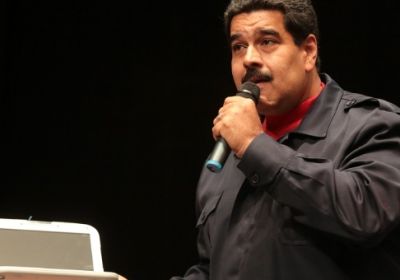
Greece, Venezuela discuss cooperation Venezuelan President Nicolas Maduro has invited the newly-elected Greek prime minister to Caracas, TeleSUR English said on February 9. “I have invited Alexis Tsipras, comrade Alexis, to visit us as soon as he can, here in Venezuela,” Maduro told Venezuelan public TV. “He plans to come to Latin America. He mentioned all the pressures that he is under. Because of a savage, savage neoliberal system that has been applied in Greece.” Tsipras expressed an interest in touring Latin America, starting with the Bolivarian Republic of Venezuela.
-
There has been plenty of analysis and navel gazing from the mainstream media in the wash-up from the Queensland elections. While some looked at the personalities, others looked for someone or something to blame. One commentator, Tom Elliott writing in the Herald Sun, laid the blame for the state of the political system on voters and suggested what he called "a benign dictatorship". -
A coup plot against the Venezuelan government has been foiled, with both civilians and members of the military detained, President Nicolas Maduro revealed on February 12 in a televised address.
-
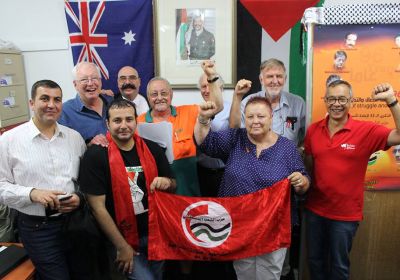
Around 60 people attended a public forum in Sydney on February 9 to commemorate the 33rd anniversary of the re-establishment of the Palestinian People's Party (PPP). The party was retitled from its original name of Palestinian Communist Party, which was founded 96 years ago. Shamikh Badra outlined the history of the PPP, from its early days in 1920s Palestine, to its re-founding in 1982. He explained the role of the PPP after it joined the Palestinian Liberation Organisation (PLO) in 1987 and fought for militant policies within the Palestinian liberation movement. -
In response the attempted blackmail by the European Central Bank (ECB) of Greece's new anti-austerity SYRIZA government in response to its bid to renegotiate its crippling debt and austerity programs, the Party of the European Left has called for mass demonstrations from February 11-17 in support of Greece. You can read about the latest developments in Greece's battle with the European elites here.
-
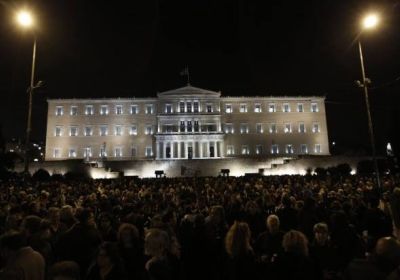
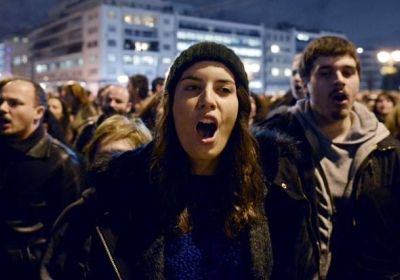
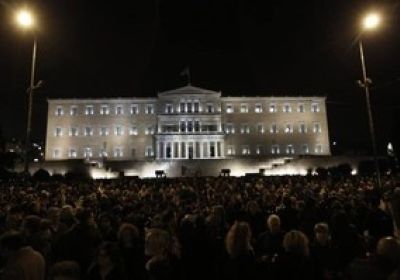
"When was the last time you saw Greeks protesting in support of the government?", Keep Talking Greece asked on February 5.
-
Leading trade unionists, Irish republican party Sinn Fein and a range of other left voices have backed a call for a new anti-austerity force in Irish politics capable of winning government. In the wake of SYRIZA’s historic win in the Greek elections on January 25, Sinn Fein national chairperson, Declan Kearney, called for formal discussions to begin on building an Irish left coalition to cohere an anti-austerity government in the South. -
If anyone was still wondering whether European politics and a Europe-wide class struggle actually exist, reactions from all quarters to the first two weeks of Greece’s new SYRIZA-led government would have cleared up any doubts.
-
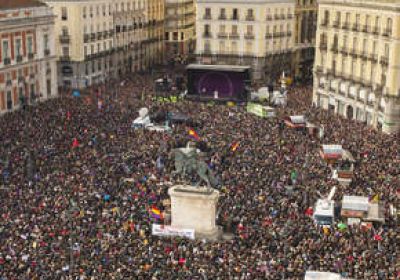
Tens of thousands of people took to the streets in Madrid on January 31 in a huge “March for Change” to support Spain's new anti-austerity party Podemos. The party has grown in support after the left-wing, anti-austerity SYRIZA party in Greece won last week's elections. This has brought hope that change could be in the air for other European countries whose debt is being used to justify austerity. On the demonstration, people chanted “yes we can” and “tic tac tic tac” ― suggesting the clock was ticking and time was running out for the political elite. -
The US’s role in Latin America is facing a growing challenge. The 33 member states of the Community of Latin American and Caribbean States (CELAC) vehemently rejected North American intervention in the continent, and particularly the US-led blockade of Cuba and recent sanctions against Venezuela. These positions were part of the “Belen Declaration”, approved during CELAC’s third annual presidential summit, held on January 28th and 29th in Belen, Costa Rica. -
The statement below was published on Transform-network.org on February 3. It has been signed by seven out of nine presidents of Germany's trade unions, all members of the executive boards of DGB and IG Metall, and mainly Social Democratic Party politicians in Germany's parliament and the European Parliament, including two vice-chairs of SPD, as well as numerous academics. * * *