Roger Burbach, the co-author of Latin America's Turbulent Transitions: The Future of 21st Century Socialism, wrote this open letter to NSA whistleblower Edward Snowden on July 15. It first appeared at www.futuresocialism.com -- where you can also order the book.
* * *
-
-
With Venezuela’s inflation rate for May soaring to 6.1%, first quarter growth stagnating at 0.7%, and shortages afflicting a number of basic goods, speculation has been rife regarding the country’s economic future. Critics from the right and left have argued these are all signs that Chavismo (the name given to the radical project for change spearheaded by former president Hugo Chavez) has reached its limits. -
WL Central wrote on July 7: NSA whistleblower Edward Snowden has now been offered asylum in three American countries: Bolivia, Nicaragua, and Venezuela. He has applied for asylum in six additional countries, according to WikiLeaks. And his chances for reaching a safe haven are growing further because of US interference in the process, according to Michael Bochenek, director of law and policy at Amnesty International.
-
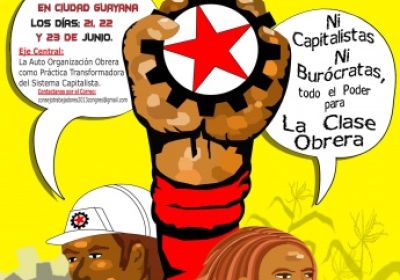
Activists from across the Venezuelan labour movement met last weekend for the country’s first ever Workers’ Congress, where workers discussed workplace democracy and the construction of socialism. The congress, billed “I Workers’ Congress: Balance and Challenges of Worker Control and Workers’ Councils for the Construction of Socialism”, was organised by the National Worker Control Movement and saw the participation of over fifty groups from factories across the country. -
The Food and Agriculture Organisation of the United Nations (FAO) recognised Venezuela on June 16 as one of 18 countries that had achieved exceptional progress toward reducing the prevalence of malnutrition. Measuring progress from 1990-1992 until 2010-2012, the FAO determined that 20 countries had cut the proportion of hungry people by half, satisfying the first of the United Nations’ Millennium Development Goals (MDG) originally set for 2015.
-
Representatives of more than 30,000 groups held a historic Popular Assembly in Caracas on June 9 to reinvigorate the Great Patriotic Pole (GPP), which united the governing United Socialist Party of venezuela (PSUV) with pro-revolution political parties and socioal movement groups. The assembly was held to discuss the future of the revolutionary alliance, and specifically the question of unified candidates for the upcoming municipal elections in December.
-
In Venezuela's April 14 presidential elections, called after the tragic death of president Hugo Chavez, the candidate from Chavez's United Socialist party of Venezuela (PSUV), Nicolas Maduro, was elected with just over 50% of the vote. In response, the right-wing opposition cried fraud and organised days of often-violent protests that lead to the deaths of eight Chavez supporters and the torching of PSUV and government offices, as well as health clinics from the government's pro-poor programs.
-
Venezuela and Bolivia have agreed to raise cooperation to a “higher level” following Venezuelan president Nicolas Maduro’s visit to Bolivia on May 25. During bilateral meetings held in Cochabamba, Maduro and Bolivian President Evo Morales signed key accords in food production, industrial development and communications. “It’s necessary to place the strategic map of bilateral cooperation at a higher level, including a more organised one,” said Maduro.
-
Founder of Venezuela’s world famous El Sistema music program, Jose Abreu, met with President Nicolas Maduro on May 22 to discuss expanding the program. They agreed on a project called Musical Program Simon Bolivar, which aims to have 1 million Venezuelan youths and children playing musical instruments.
-
Registrations are now open for the Australia-Venezuela Solidarity Network’s (AVSN) next brigade to revolutionary Venezuela. The solidarity tour, to run over December 4-13 this year, will be a special one for the AVSN, the first since the election of President Nicolas Maduro following the death of Hugo Chavez on March 5. Since 1998, when Chavez was first elected president, the Bolivarian revolution has achieved remarkable things by putting control of Venezuela’s politics and economy back into the hands of the poor majority.
-
The open letter printed below, which was sent to the New York Times public editor Margaret Sullivan was signed by more than a dozen experts on Latin America and the media. Signatories to the letter, released on May 14, signatories included academic Noam Chomsky, filmmaker Oliver Stone, Venezuela Analysis founder Gregory Wilpert and several other experts. To join the campaign, visit New York Times Examiner. * * * Dear Margaret Sullivan,
-
Venezuela's new Labour Law for Workers came into effect on May 7, guaranteeing shorter working hours, longer maternity leave and pensions for all Venezuelans. Described by the Venezuelan government as the “most advanced labour law in the world”, the law reduces the working week from 44 hours to 40, and requires that employers provide two consecutive days a week off. When the law came into effect, labour minister Maria Iglesias said the new working hours are part of the process towards a “just distribution of wealth”.