
One of the big challenges facing Cuba as it designs climate change adaptation policies is the preservation of its coastal ecosystems against the predicted rise in sea level and increasingly catastrophic extreme weather events.
With the country’s 5500 kilometre of coastline and 4000 cays and islets, almost everyone on the Cuban archipelago feels their life is tied to the sea in one way or another.
“It’s lovely, but it is also dangerous,” said 78-year-old Teresa Marcial, who lives on the coast in Santa Fe, in the northern outskirts of Havana.
-
-
The Sindh Progressive Committee (SPC), which brings together activists from the Labour Party, Workers Party, Communist Party, Jeay Sindh Mahaz, National Party, Awami Party and Watan Dost Inquilaabi Party, held a rally on April 17 outside the Hyderabad Press Club in the southern Sindh province. The rally protested against the kidnapping, forced conversion to Islam and forced marriage of young Hindu women.
-
 The Coalition of Free and Fair Elections (known as Bersih — which means “clean” in Malay) called for a mass sit in on April 28. It did so due to suspicions that the country’s Barisan Nasional (BN) government was about to call a general election before addressing widespread electoral irregularities. The irregularities were confirmed by a review forced on the government by the previous Bersih 2.0 mass rally on July 9 last year.
 -
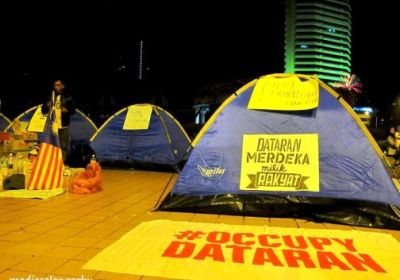
At 2.36am, in the early hours of April 19, the student and Occupy Dataran encampment in Kuala Lumpur was violently ambushed by a big group of men. After the ambush, everyone sat down, and victims of violence started to tell stories of what happened. Here is a brief summary of the stories.
-
Venezuela’s national minimum wage is to rise 32.25% this year, Venezuelan President Hugo Chavez said on April 7. In a televised address from Miraflores presidential palace in Caracas, Chavez said the wage rise would take place in two phases, ― first on May 1 and then a further rise on September 1.
-
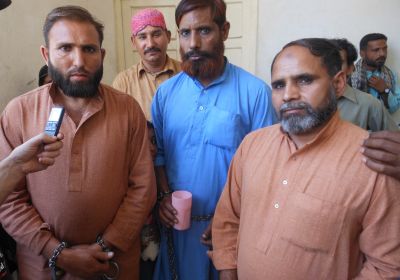 Power loom workers in Faisalabad, a big industrial centre in central Pakistan, launched a series of strikes and demonstrations in mid-2010. Six leaders of the organisation of power loom workers, the Labour Qaumi Movement (LQM), were arrested by the police. The six were charged under anti-terror laws and sentenced to a total of almost 490 years' jail (served concurrently). The jailed LQM leaders are also members of the Labour Party Pakistan (LPP).
 -
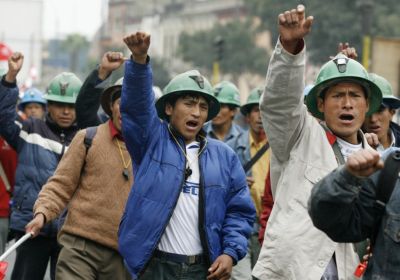 Tintaya is an open-cut copper and gold mine 4000 metres high in the district of Yauri, Espinar province, southern Peru. It is a spectacle of modern industrial devastation that contrasts jarringly with the timeless beauty of the surrounding altiplano landscape. Finally, after years of aggravated environmental abuse, the mine's owner, Swiss-based Xstrata, will be investigated by Peruvian authorities. After the discovery of large deposits, a copper mine was established at Tintaya in the mid-1980s. Extractive operations were hugely expanded when BHP bought the site in 1996.
 -
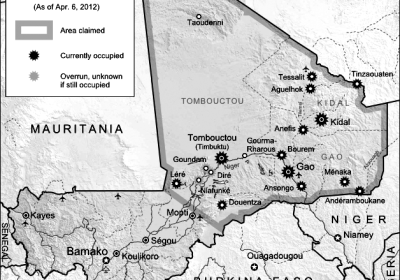 The new, interim president of Mali is holding out the possibility of “all out war” against the rebellion of the oppressed, Touareg nationality that has swept the north of the western African country. Dioncounda Traore took over the presidency on April 12 in a deal with the military officers who overthrew the elected president on March 21. He immediately called on the rebels to "return to the fold and to strengthen this nation instead of dividing it". BBC reported on April 12 that Traore said if they did not yield, "we will not hesitate to wage a total and relentless war".
 -
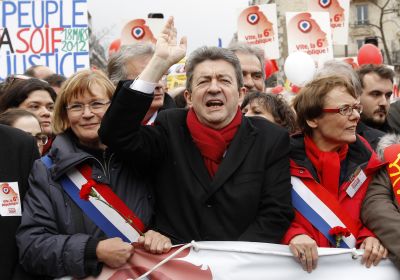
There’s no election quite like a French presidential contest. It is a six-month-long race in which nearly every political stable usually has a runner and where the handicapping system is less rigged against “outsiders” than in many other countries.
-
 Literature Nobel laureate and Germany's most famous living author Gunter Grass labelled Israel a threat to "already fragile world peace" in his poem “Was gesagt werden muss” (“What must be said”). The work, published by German daily Sueddeutsche Zeitung on April 4, accuses "the West" of hypocrisy in relation to the arming of Israel. In publishing the poem, Grass, who regards himself as "irrevocably connected to the country of Israel” has made a big contribution to breaking a long standing German taboo about publicly criticising Israel's warmongering.
 -
About 215,000 public service workers struck on March 27 as a warning to their employers a day before talks between the public sector union and the bosses. Two weeks earlier, 130,000 took part in the first round of strikes. The award being negotiated by the United Services Union (known as ver.di) covers more than 2 million public service workers from national to local level. Ver.di is Germany's second biggest union, with a membership of about 2.1 million people.
-
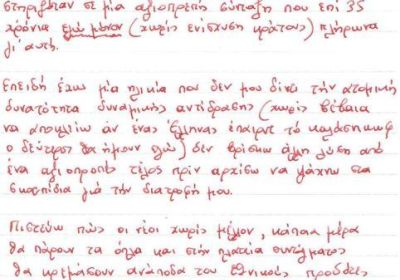
“The Tsolakoglou Occupation government has literally crushed my prospects for survival, so far based on a decent pension, which I alone (without supplementation from the State) financed over 35 years.” That was how the suicide note left by 77-year-old retired pharmacist Dimitris Christoulas began. It likened the current government to the collaborationist regime during the German occupation in World War II, led by Georgios Tsolakoglou. He was arrested and tried for his role.