More than 400 members of the Left Unity party project gathered in London on November 30 for the party's founding conference.
The fledgling project has its origins in a call earlier in the year for a new party to the left of Labour made by veteran left film maker Ken Loach. Against the backdrop of the most brutal austerity experienced in Britain for generations and with the British left fractured, the call met with strong support.
-
-
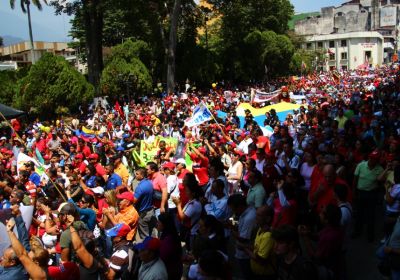
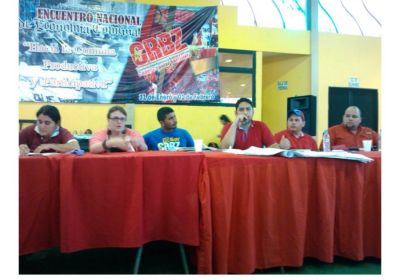
Hundreds of community activists gathered in downtown Caracas on November 16 and 17 to demonstrate their steadfast support for the socialist policies of Venezuelan President Nicolas Maduro. Maduro used the occasion to repeat: “Venezuela’s communes must be consolidated if we are to truly carry out the program elaborated by our leader, Hugo Chavez.” -
The National Electoral Council (CNE) has announced the first results of the Venezuelan municipal elections held on December 8. Mayors and local councilors were elected for the country’s 335 municipalities, as well as the metropolitan mayor of Caracas. CNE president Tibisay Lucena read out the results. Turnout was 58.92%, with 97% of votes counted so far. The results for 77% of mayoralties were announced, with the ruling United Socialist Party of Venezuela (PSUV) and its allies winning 196 so far, of the 257 mayoral position results that are so far irreversible.
-
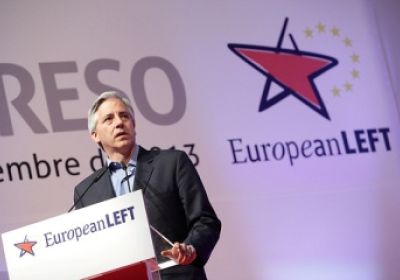
“For millions of people, the European dream has turned into a nightmare,” Alexis Tspiras, the leader of Greece's Coalition of the Radical Left (SYRIZA), said in a November 28 opinion piece in The Guardian. Tsipras was explaining why he will campaign on behalf of the European Left party for president of the European commission in elections next May. He said he was driven by the “desire to reunite Europe and rebuild it on a democratic and progressive basis. There is an alternative to the present crisis and it is our duty and destiny to fight for it.” -
“When we went out, it was like a Zombieland,” Zoreen Agustin, a student at the University of the Philippines’ (UP) Tacloban campus told me on December 2. “A lot of people were walking around, some with no shoes and their clothes all torn, a lot of people were covered in cuts.” She was referring to what she saw after Tacloban, and much of the Eastern Visayas region, were demolished by Super Typhoon Yolanda (known as Typhoon Haiyan outside the Philippines) on November 8. The storm, one of the strongest on record to hit land, killed anywhere between 5000 and 10,000 people. -
It’s wrong to think that we can campaign to stop climate change in the same way we might campaign to end a war. All the evidence says we are well past that stage now. That is, even if by some impossible, magical course of events all carbon pollution on Earth was stopped tomorrow, we’d still be in really, really deep trouble. So many greenhouse gases have been pumped into the Earth’s atmosphere that we have rushed far past the safe upper limit — the famous 350 parts per million of CO2, the number that climate action group 350.org took for its name. -
The unity discussions between the Socialist Alliance and Socialist Alternative have come to an end. In a November 3 letter on behalf of the Socialist Alternative National Executive, Mick Armstrong wrote: “The overall political projects of both organisations are not sufficiently similar to carry through a sustained and productive unity that could advance the cause of the revolutionary left in Australia and the broader class struggle.” The Socialist Alternative letter lists four major political differences: -
Local citizens voted to create 169 new communes on November 24, deepening efforts to create forms of communal organisation in the South American country. A recent national census found there are more that 40,000 active communal councils in Venezuela. These are local participatory bodies that develop their communities and can receive public funding. Communes are based on groups of communal councils, and can take on larger -scale projects and economic activities.
-
Undesirable: Captain Zuzenko & the Workers of Australia & the World By Kevin Windle Australian Scholarly Publishing, 2013 274 pages, $39.95 (pb) On November 7, 1917, when the Winter Palace was stormed in Petrograd, sealing the victory of the Russian Revolution, Alexander Mikhailovich Zuzenko, one of the revolution’s most loyal servants, faced a local court in Ingham in northern Queensland. He was working on the canefields and was fined 10 shillings for losing his “aliens registration certificate”.
-
Lurid articles about Venezuela have peppered the Western press in recent days and weeks. The latest event that has been widely reported is the use of the military to occupy stores, including the national electronics chain Daka, with a mandate to sell products at “just prices”. This is viewed by most media outlets as further evidence of the chaotic mismanagement of the economy by the government. However, while there are serious economic problems in Venezuela, this one-sided portrayal prevents an informed debate.
-
Venezuela’s National Assembly granted President Nicolas Maduro the power to pass laws by decree on economic and anti-corruption issues for a period of 12 months on November 19. The National Assembly held a second and final vote on a proposal from Maduro to enact the so-called enabling law, which allows him to legislate by decree on specific issues for the period set by the assembly. Maduro has been empowered to pass laws to “fight corruption, usury, money laundering and the economic war unleashed in recent times against the country by the national oligarchy”.
-
Kshama Sawant, an openly declared socialist, was elected to the city council in a major United States city, Seattle, in November’s ballot. You need to go back to the first half of the 20th century to find anything similar in the US.