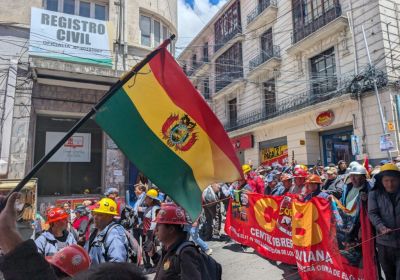
Bolivia

Bolivia nationalises power company on May Day

Bolivian President Evo Morales once again used the opportunity of May 1, the international workers’ day, to announce his left-wing government's latest nationalisation. This time, it was the turn of Transportadora de Electridad (TDE), a subsidiary of the Spanish-owned Red Electrica de Espana (REE), which controlled Bolivia’s national electricity transmission grid.

The nationalisation was another step towards meeting the long-standing demand of the Bolivian people to return privatised companies to state hands.

Bolivia: 'Moving beyond capitalism is a universal task'

Bolivia’s vice-president Alvaro Garcia Linera brought a message of hope and anti-imperialist commitment to Mexico in early February.

Speaking to an overflowing assembly of students and university personnel at Mexico City’s UNAM (National Autonomous University), he said the left-wing government led by President Evo Morales welcomes social-movement protests and conflict. The more, the better.

“The struggle is our nourishment, our peace,” Garcia Linera said. “It does not overwhelm us. Absolute calm frightens us.

Bolivia: Referendums of reaction

On June 1, the eastern Bolivian provinces of Beni and Pando followed the May 4 referendum in Santa Cruz, holding referendums for “autonomy” from the national government. Together with Tarija, whose “autonomy” referendum is scheduled for June 21, these four eastern provinces, known as the “half moon”, are a stronghold of the right-wing oligarchy that is attempting to destablise the government of President Evo Morales.

Tags:

Latin America: Anti-imperialist bloc expands

Member countries of Latin America’s alternative integration bloc, the Bolivarian Alliance for the Peoples of Our America (ALBA), met for its 11th summit in Caracas on February 4 and 5 to discuss advancing the organisation.

ALBA is made up of the governments of Venezuela, Cuba, Bolivia, Ecuador, Nicaragua, Dominica, Saint Vincent and the Grenadines, and Antigua and Barbuda. Formed in 2004, ALBA seeks to develop trade on the basis of solidarity and cooperation.

ALBA giving hope and solidarity to Latin America

Seven years after being launched by the Venezuelan and Cuban governments, the Bolivarian Alliance for the Peoples of Our Americas (ALBA) has become an important voice on the global stage willing to stand up and denounce capitalism.

ALBA has grown to include eight Latin American and Caribbean countries (Venezuela, Cuba, Bolivia, Ecuador, Nicaragua, Antigua and Barbuda, Dominica, Saint Vincent and the Grenadines.

Bolivia: Rumble over jungle far from over

espite the government reaching an agreement with indigenous protesters on all 16 demands raised on their 10-week march onto the capital, La Paz, the underlying differences are far from resolved.

On October 24, Bolivia’s Plurinational Legislative Assembly approved a new law banning the building of any highway through the Isiboro Secure National Park and Indigenous Territory (TIPNIS).

See also:
Bolivia: Solidarity activists need to support process

Bolivia: Solidarity activists need to support process

The recent march in Bolivia by some indigenous organisations against the government’s proposed highway through the Isiboro Secure National Park and Indigenous Territory (TIPNIS) has raised much debate among international solidarity activists.

Such debates have occurred since the election of Bolivia's first indigenous president, Evo Morales, in 2005 on the back of mass uprisings.

See also:
Bolivia: Rumble over jungle far from over

Bolivia: Conflict deepens over disputed highway

September 25 will go down as one of the darkest days in Bolivia since Evo Morales was elected as the country’s first indigenous president almost six years ago.

After more than 40 days of indigenous protesters marching, police officers moved in to repress those opposed to the government’s proposed highway that would run through the Isiboro-Secure National Park and Indigenous Territory (TIPNIS).

See also
NGOs wrong over Morales, Amazon

Bolivia: Conflict deepens over disputed highway

September 25 will go down as one of the darkest days in Bolivia since Evo Morales was elected as the country’s first indigenous president almost six years ago.

After more than 40 days of indigenous protesters marching, police officers moved in to repress those opposed to the government’s proposed highway that would run through the Isiboro-Secure National Park and Indigenous Territory (TIPNIS).

The controversial highway has met with both opposition and support from the many indigenous and social organisations that form the Morales government’s support base.

Bolivia: NGOs wrong on Morales and Amazon

Statements, articles, letters and petitions have been circulating on the internet for the past month calling for an end to the "destruction of the Amazon".

The target of these initiatives has not been transnational corporations or the powerful governments that back them, but the government of Bolivia's first indigenous president, Evo Morales.

See also:
Bolivia: Conflict deepens over Amazon highway plan

Syndicate content