
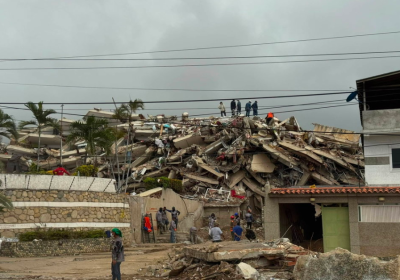
After the June earthquakes, United States and Israeli troops have arrived in Venezuela, but economic and political interests, not humanitarian recovery, appear to be driving their presence, writes Jessica Dos Santos Jardim.
After the June earthquakes, United States and Israeli troops have arrived in Venezuela, but economic and political interests, not humanitarian recovery, appear to be driving their presence, writes Jessica Dos Santos Jardim.

United States sanctions ensure that most of the foreign currency Venezuela generates from oil sales remains under US control, drastically limiting the funds available for reconstruction following the recent earthquakes, writes Venezuela's Autonomous and Independent Workers’ Committee.

In the aftermath of Venezuela’s devastating twin earthquakes,reconstruction must not follow free-market logic nor become a source of profits for financial elites, argues Venezuela’s Autonomous and Independent Workers’ Committee.

Calls are mounting on the United States and other countries to lift all sanctions against Venezuela in the wake of the devastating earthquakes, which have so far killed more than 950 people and injured thousands more, reports Kerry Smith.

Venezuela suffered two successive major earthquakes on that caused devastating damage, reports Venezuela Analysis.

The United States launched a military strike inside Venezuelan territory in a 'joint operation' with the Venezuelan government, on June 12, that reportedly killed Héctor “Niño” Guerrero Flores, an alleged leader of criminal group Tren de Aragua, reports Ricardo Vaz.

While social movements in the rest of the region are pushing back against anti-popular economic policies, in Venezuela, the process of state restructuring has accelerated since the January 3 United States bombing, writes Manuel Azuaje Reverón.

Coral Wynter reviews Chris Gilbert’s 2023 book, Commune or Nothing: Venezuela’s communal movement and its socialist project, one of the best available accounts of Venezuela’s communal movement.

In the second of our two-part interview, Green Left’s Federico Fuentes speaks to Elias Jaua — Chavista, socialist and former vice-president of Venezuela under President Hugo Chávez — about the response inside the country to the January 3 US military assault, the Nicolás Maduro government, the state of the United Socialist Party of Venezuela and popular participation today.

Green Left’s Federico Fuentes spoke to Elias Jaua, who explained how Venezuela came to be “militarily occupied and subjected to a policy of coercive tutelage” and why Venezuelans will need to wage a struggle for national liberation.

Santiago Mayor speaks to Venezuelan sociologist Reinaldo Iturriza about the political significance of Venezuela’s communes and where they stand today.

Santiago Mayor interviews Reinaldo Iturriza, a Venezuelan sociologist, writer and political activist, about the state of Chavismo following the United States’s attacks on Venezuela.